Maintenance
Part of Planning a backyard studio around trades, panels and one mini-split
Aftercare questions to ask backyard studio builders
Aftercare questions to ask backyard studio builders: warranty start dates, handover files, maintenance conditions, roof access and service visits.
What to take away
- The warranty start date is the first term to pin down with backyard studio builders, because completion, delivery and final inspection are three different days.
- Ask for the handover file as a named contract deliverable, not a folder handed over on the last morning.
- Most warranties carry maintenance conditions. Get the list at handover and put the dates in a calendar.
- Agree how the roof edge and gutters will be reached before you need them reached.
- Get the claims process in writing, including who to contact after the defects period ends.
Get the handover file written into the contract
A handover package should be a contract deliverable with a list attached, not a gesture on the final morning. Ask for final drawings showing what was actually built, the building permit and inspection records held by your local building department, and the certificate of occupancy or final sign-off that closes the permit.
Then the items nobody photographs until they are buried: the trench, the framing, the wiring runs, the insulation. Add product names and serial numbers for windows, doors and equipment, plus manuals and warranty registration details. Paint references and leftover materials save a colour match later.
Without that file, every repair starts with guesswork, and a buyer's inspector will ask for exactly these items. It is the first thing on the list of what owners wish they had kept.
Warranty questions to settle before signing
| Question | Why it matters |
|---|---|
| When does the period start | Completion, delivery and final inspection are different dates |
| What is covered separately | Structure, weather tightness, equipment and finishes often run on different terms |
| Who covers the joints | Where factory panels meet site work is the usual gap |
| What voids it | Pressure washing, owner alterations and missed maintenance are common exclusions |
| How claims are made | A named process beats a phone number |
| What happens if the builder closes | Manufacturer warranties usually survive; company promises usually do not |
Owner-supplied items are a common exclusion, which is worth weighing when you decide which upgrades to buy from the builder and which to source yourself. Ask for each period separately rather than accepting one headline number.
For a sense of scale, a state new-home warranty shows how split periods look. New Jersey's new home warranty program covers defects in materials and workmanship for one year, the design and installation of heating, air conditioning, plumbing and electrical systems for two years, and major structural defects for ten years. The same program lists outbuildings among its exclusions, which is why the terms for a backyard studio are usually the ones in your own contract with the builder.
Written warranties on the products inside the studio, such as windows, doors and mini-split units, fall under the federal Magnuson-Moss Warranty Act. A written warranty on a consumer product must be titled either "full" or "limited", and a "limited" title tells you the coverage falls short of at least one of the Act's standards, so read which one you are being offered.
Maintenance conditions are obligations, not advice
Many warranties depend on work you are expected to do: clearing gutters in spring and fall, servicing filters on the equipment schedule, renewing sealant when it cracks or pulls away, keeping vegetation off the cladding, and reporting defects inside a stated window. Ask for that list at handover and diary it.
A dated record with photographs is the part people skip and the part that decides a disputed claim. It also matters if a claim escalates beyond the builder. California's Contractors State License Board, for example, addresses violations of the state's contractors license law for up to four years from the date of the act, and will ask whether you have formally notified your contractor of your concerns; it suggests saving a copy of that letter to submit with a complaint. Other states route complaints through their own contractor licensing board, so note yours at handover.
Settle how height access will work
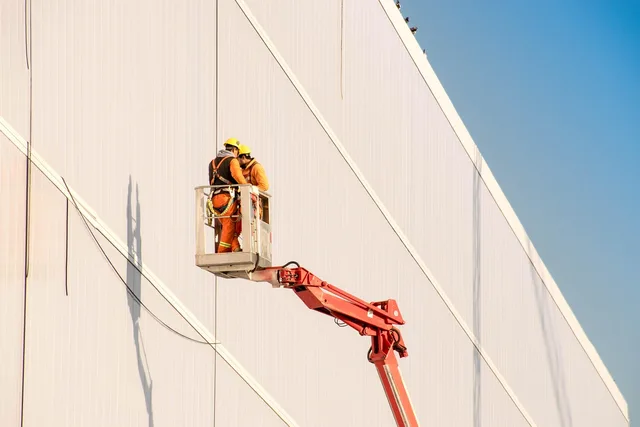
A studio needs roof edge, gutter and sealant attention over its life. Agree how that happens rather than improvising it later. If the roof is high, steep or awkward to reach, the honest answer is a contractor with the right access equipment — a stabilizer on the ladder, a rolling scaffold or a boom lift — not a chair on a patio table.
That equipment has its own requirements. Platforms have to be built, supported and used correctly, which is what OSHA's scaffolding general requirements address for construction work. Improvised platforms are where people fall, and budgeting for proper access is cheaper than the alternative.
The defects period is the window after handover in which the builder agrees to come back and fix faults in materials and workmanship at its own cost; its length is whatever the contract states. Ask who to contact once the defects period ends, and whether the builder keeps a record of what went into your building. Get a named person, a phone number and an email address rather than a general office line, because firms that keep project files answer in minutes what otherwise costs a site visit.
Ask about a service arrangement
Some builders offer a first-year check or an annual visit. Ask what it covers, what it costs and whether any warranty requires it. The visit scheduled just before the defects period ends is usually the highest-value item on the list.
Set the routine out in a calendar as soon as the building is handed over, using the first year upkeep plan as the starting structure, and check the terms against the market practices worth knowing.
Common questions
A well-run handover leaves you with a file, a set of dates and a name to call. These are the questions that settle each of those, in the order they come up.
How long should a warranty be?
There is no standard length for a backyard studio, so the number is the one your contract sets; a state new-home program such as New Jersey's is a useful yardstick for how periods split by element. Ask for each period separately: structure, weather tightness, equipment and finishes. The start date matters as much as the length, because a period that begins at completion runs while the building is still empty.
What if the builder stops trading?
Manufacturer-backed warranties on windows, doors and equipment usually survive because they sit with the product. Company promises usually do not. Keep the registration paperwork for anything with a manufacturer warranty.
Do I have to report defects in writing?
Almost always, and often inside a set period. Read the claims process before you need it, and keep dated photographs of anything you report.
Is an annual service visit worth paying for?
Often, and especially the one before the defects period ends. Ask what it covers, what it costs, and whether a warranty makes it mandatory.