Reviews
Prefab studio sheds: six quote comparison criteria
A checklist for comparing prefab studio sheds: completion, access, foundation tolerance, permits, exclusions and warranty responsibility before you buy.
What to take away
- For prefab studio sheds, compare level of completion first. Two prefab quotes rarely include the same amount of building.
- Access decides the shortlist. If the truck or crane cannot reach the spot, nothing else matters.
- Ask who warrants what. Factory and site work usually carry separate warranties, with a seam between them.
- The foundation tolerance is the manufacturer's stated requirement, not your builder's preference.
Compare on completion, not on photographs
Prefab covers a wide range. At one end, a flat pack panel set that needs everything. At the other, a finished module with wiring, insulation, flooring and a heat pump already installed. Both are advertised the same way.
Use this comparison sheet to make every supplier quote the same scope. Record the supplier's answer and quoted amount for each item; ask for written details rather than accepting blanks or verbal assurances.
- Completion and envelope:Is the quote for a panel set or a finished module? Record what is included, the wall build, and the stated R-values for the floor, walls, and roof. Ask which energy requirements apply to your intended use.
- Delivery and access:Record the delivery method, required truck access, crane needs, and who pays for each.
- Foundation:Record the proposed type, such as a slab, piers, or piles. Ask for the manufacturer's levelness tolerance in writing, including its units and measurement method.
- Price and exclusions:Request an itemized quote with dollar amounts. Compare site preparation, foundation, delivery, crane, permits, utility connections, steps and paths, and yard restoration.
- Permits and approvals:Ask what approval applies to the exact model and who obtains it. Confirm site requirements with your local building department.
- Warranty:Record the term, start date, coverage, exclusions, and the responsible party for the module joint, foundation interface, and utility penetrations.
Force every supplier onto this sheet
- Wall construction, depth, insulation as assembly
- Window and door spec, performance, factory flashing
- Electrical work included, and where it stops
- Heating and cooling supplied, installed, or neither
- Interior finish, floor covering, trim complete
- Exterior finish, overhang, gutters, cladding state
What arrives, and how
A unit built in a factory is assembled indoors under general industry conditions rather than on an open site, which is part of the quality argument for the method. OSHA's overview of general industry concerns workplace safety; it does not certify a studio or establish that it meets local building requirements. Treat repeatability as a supplier claim and ask for documentation of the inspections and approvals that apply to the unit.
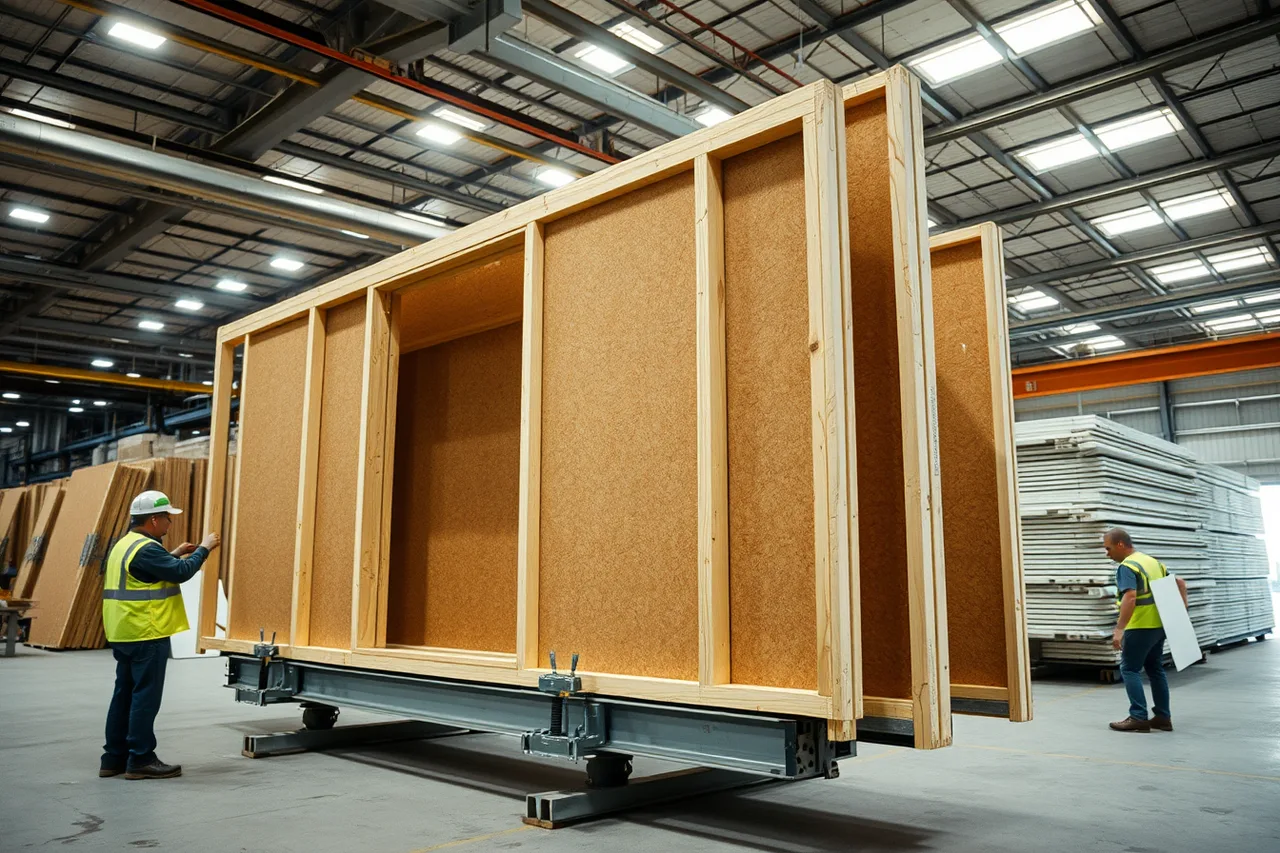
Panel systems and composite building products depend heavily on how they are made and handled. OSHA's material on the composites industry addresses workplace hazards, not building-code approval or product certification. Ask what code evaluation or approval applies to the exact model, and whether your state has a modular-building approval program. HUD Code applies to manufactured homes, not automatically to every backyard studio shed; if a supplier says the unit is HUD-code compliant, ask for its certification label and data plate. A reference to ICC/MBI off-site construction standards is not, by itself, a local permit or approval.
Local code compliance traces back to a model code. Most US jurisdictions adopt the International Residential Code (IRC) for one- and two-family dwellings, or the International Building Code (IBC) for larger and non-residential work, with state and local amendments on top. Where a state runs a modular building program, that program is usually administered by a state building-code or housing agency. Ask which model code edition your jurisdiction enforces and whether the exact model you are buying has been evaluated to it.
The site side of the comparison
| Question | Why it decides the shortlist |
|---|---|
| Truck route and turning space | Rules out modules on tight lots quickly |
| Crane position and swing radius | Needs clear ground and no overhead lines |
| Foundation type and tolerance | Set by the manufacturer, not negotiable |
| Who prepares the site | The most common gap between quotes |
| Utility connection responsibility | The second most common gap |
| Restoration of the yard afterward | Frequently excluded entirely |
Measure the narrowest point on the access route yourself, in both width and height, and take photographs. Suppliers ask for this and it is faster to have it ready. An unchecked route is what turns delivery and crane day from a morning into a lost week.
Warranty seams
Ask for the warranty documents before signing, not after. Warranty terms vary, so get the length, start date, coverage, and exclusions in writing for both the factory build and site work. Water entry at the module joint, at the foundation interface, or at a utility penetration is where the seam gets tested.
Get one document that names, for each of those three locations, who is responsible and how long that work is covered. If nobody will put a name and term against them, that is your answer about the supplier.
Read the exclusions before the price
The exclusion list is the most useful page in any prefab quote. It lists site preparation, foundation, delivery, crane, and permits. Ask the supplier to show the dollar amount for each included item and identify who handles any permit application.
It also lists utility connections, steps and paths, and yard restoration. Compare exclusion lists side by side; price differences explain themselves, and what the cheapest quote leaves out is the site work and services that decide the real total.
Compare factory options by their written specifications and added cost, not by a sales description alone. Before you place a deposit, get the scope, exclusions, approval responsibilities, and warranty terms in writing, and settle the checks on whoever installs it.
Common questions
Is prefab faster?
Does the factory handle my permit?
What if the unit does not fit through the gate?
Can I change the layout?
In this guide
- How to vet installers for prefab studio shedsFor prefab studio sheds, responsibility splits between factory, dealer and local installer. Here is how to verify each one before you pay a deposit.
- Which prefab studio shed options only make sense at the factoryFactory options you cannot add later, options better bought locally, and the prefab upgrades that quietly improve a studio every day you use it.
- Prefab studio sheds: the first-year check and logPrefab studio sheds need checks from delivery through the first year. Inspect joints and anchors before the warranty deadline, and keep a transferable log.
- Prefab studio sheds: what to check for your climatePrefab studio sheds are built to a standard spec for a mild climate. Here is what to ask about snow, wind, insulation, humidity and anchoring.
- Prefab Studio Sheds: Screen Factory Sealants Before OrderingBefore ordering prefab studio sheds, request safety data sheets for factory-applied sealants and finishes, then check hazards and ventilation guidance.