Costs
Backyard office bathroom without a sewer line: the three routes and their permits
A backyard office bathroom without a sewer line can run on a septic system, a holding tank or a composting or incinerating toilet. This guide names the permit authority and the state rule for each route in Washington, Texas and Wisconsin, and what to ask for in writing.
What to take away
- Without a sewer line, the three routes are a septic system, a holding tank that is pumped out, or a composting or incinerating toilet. Each has its own permit path, set by state onsite sewage rules and issued locally.
- Septica permit and approved plan from the local health authority, after a soil test. Holding tank: the same authority, plus a pumping arrangement, and some states bar it for homes.
- Composting and incinerating toiletsthe unit must be a listed model (NSF/ANSI 41, plus ANSI Z21.61 for incinerating). Where the office has running water, some states still require a septic system.
- Rules differ by state and county. The examples below come from Washington, Texas and Wisconsin. Your own health department decides.
What this article does not price
Permit fees, pump-out charges and installed prices differ by county and installer, and none is sourced here. Ask each authority for its current fee schedule and each installer for a written quote. The line items below let you compare quotes like for like.
The chart is a comparison aid only. Where no sewer exists, the septic, holding tank or toilet route sets the number, as the sections below explain.
Line items for a no-sewer job
The table lists what a no-sewer bathroom quote usually breaks out, and what sets each price. Not every line applies to every route.
Quote line items
- $150-$1,200 | Permit and plan review
- $500-$4,000 | Municipal sewer tap fee
- $2,000-$12,000 | Trench and pipe to main
- $1,500-$5,000 | Grinder pump, basin, alarm
Line item / What sets the price
- Permit and plan review
- The health department or county fee schedule
- Soil or percolation test (septic)
- The site evaluator's rate and the number of test pits
- Tank and drain field or mound (septic)
- Soil, lot size and system design
- Tank and alarm (holding tank)
- Tank capacity and the required high-level alarm
- Pumping contract (holding tank)
- The hauler's rate and how often the tank fills
- Toilet unit (composting or incinerating)
- The listed model; incinerating units also need power or gas
- Water supply line at frost depth
- Frost depth and run length
- Vent stack and roof flashing
- Number of roof penetrations
- Inspection revisits and corrections
- Failed inspections
A sink and toilet need less of this list than a full bath. A checklist for ordering the inspection gates on a studio shed helps you sequence the trades so plumbing is not an afterthought.
No sewer line: the three routes and who permits each
In every state the building sits under a state onsite sewage rule, and a local office issues the permit. The table gives examples from three states. It is a starting point, not a legal list.
| Route | Washington | Texas | Wisconsin |
|---|---|---|---|
| Septic | Local health officer permit under WAC 246-272A | Permit and approved plan from TCEQ or its local authorized agent, 30 TAC Chapter 285 | County sanitary permit under SPS 383 |
| Holding tank | Generally barred for residential development (WAC 246-272A-0240) | Allowed only where other methods are not feasible (30 TAC 285.34) | Sanitary permit and plan approval under SPS 383 |
| Composting or incinerating toilet | Model on the state Department of Health registered products list, then a local permit | Composting toilets approved by TCEQ when certified to NSF/ANSI 41 | Non-plumbing sanitary system application to the county under SPS 391 |
Septic system. The septic route needs the most paperwork. Most jurisdictions require a soil or percolation test and a scaled site plan before the permit. Poor soil or a mound system adds cost, and replacing a failed drain field costs more again. Ask the health department for its current application and fee schedule.
Holding tank. A tank stores waste until a licensed hauler pumps it out. Texas allows it only where other disposal methods are not feasible. The rule requires a high-level alarm that sounds at 75 percent of capacity, room for one week of flow, and a pumping contract filed with the permitting authority before installation. Washington generally bars holding tanks for residential development, with narrow exceptions and a management program filed before permit. Ask whether an office beside a house counts as residential.
Composting or incinerating toilet. These units are regulated as non-water-carried systems, not as plumbing fixtures. In Wisconsin, a county non-plumbing application names the model, requires NSF/ANSI 41 for composting units and ANSI Z21.61 for incinerating units, and sends any liquid to a sewer or a septic system under SPS 383. Douglas County's form, for one, says a building with pressurized water must use a septic system. Washington lets a composting toilet run with potable water only alongside an approved greywater system or a sewer.
A building or electrical permit from the city or county building department may also apply when the office is occupied, and an incinerating unit needs a power or gas connection.
Every route needs a written quote and a permit answer from the authority that issues it. Treat any online figure as a starting point, not a bid.
What moves the number
- Soil and site. A failed soil test pushes a septic design toward a mound or a holding tank, and the lot's setbacks can limit where a tank or drain field fits.
- Depth. Water lines and tank piping must sit below the frost depth and snow load for your area. Deeper trenches mean shoring, more spoil and more backfill.
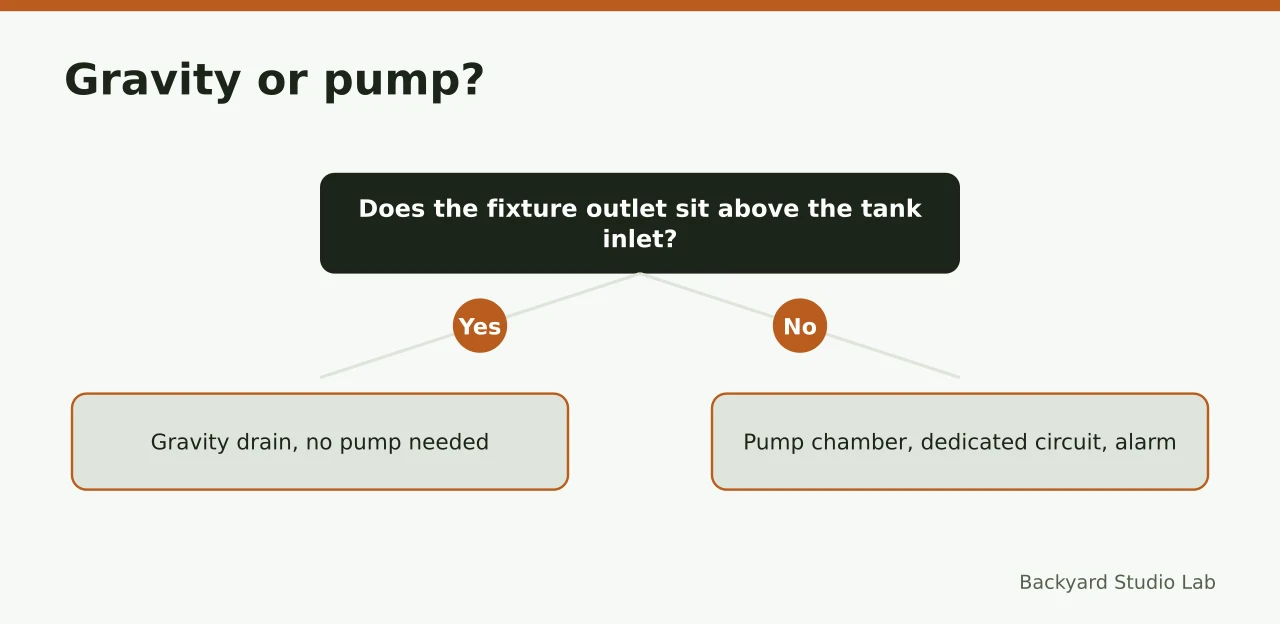
- Gravity. If the office fixture outlet sits below the tank inlet, you need a pump chamber, a dedicated circuit and an alarm.
Every trap also needs a vent that reaches open air, which is why roof penetrations appear even in a small room. Many US jurisdictions adopt the International Plumbing Code, often with local changes, while others use a different plumbing code. The code itself is worth reading before a plumber prices the vent run, and the local code is the one that applies.
What quotes leave out
Plumbing quotes usually cover the plumbing scope only. A septic quote often leaves out the percolation test and the health department permit. A holding tank quote often leaves out the pumping contract and the alarm wiring.
Ask each bidder for the soil test fee, the permit fee, the pump-out schedule and the restoration line in writing. Two bids that look far apart often differ only in what each one left out.
Several of the permit expenses on a backyard studio begin as line items no one priced.
Where people overspend
Overspending here is about scope, not the toilet.
- Adding a shower when a sink and toilet satisfy both the permit and the actual use.
- Running hot water to a building used two days a week.
- Installing a full septic field to serve one fixture, when a smaller system and a composting toilet may meet the permit.
- Buying a pump chamber before confirming that gravity will not work.
Example: choosing a route for a small office
This example is illustrative and uses no published prices. Suppose a homeowner adds a toilet and a sink to a small backyard office on a lot with no sewer main. The office has running water, so the homeowner first asks the county whether a composting toilet is allowed at all.
If the county requires a septic system, the soil test comes first. If the soil fails, a holding tank may be the next question, and the pumping contract becomes a standing cost. The homeowner would compare each route against its written quote and its permit answer.
Pipes in a shed foundation can move as the building settles. Check the joints and the anchors in the first year, as covered in the prefab shed first-year check.